Product Updates7 min readby José

Build in Public, Week 1: 9 Providers, Stripe Live, and a Legal Stack in 5 Days

What we shipped in the first week after Sherlock Calls launched: 9 provider integrations, Stripe live mode, competitor comparison pages, GDPR compliance, and the interactive demo in progress. The full evidence file.

TL;DR — The short answer

  • 1

    Week 1: 9 provider integrations (Twilio, ElevenLabs, Vapi, Retell, Genesys, Amazon Connect, HubSpot, Datadog), free Starter plan, Stripe live mode, email onboarding flows, and GDPR compliance stack.

  • 2

    Added competitor comparison pages, an auto-scrolling integrations carousel, and the automated blog pipeline — SEO infrastructure that compounds over time.

  • 3

    Ended the week with the interactive demo in progress and the viral loops system fully designed.
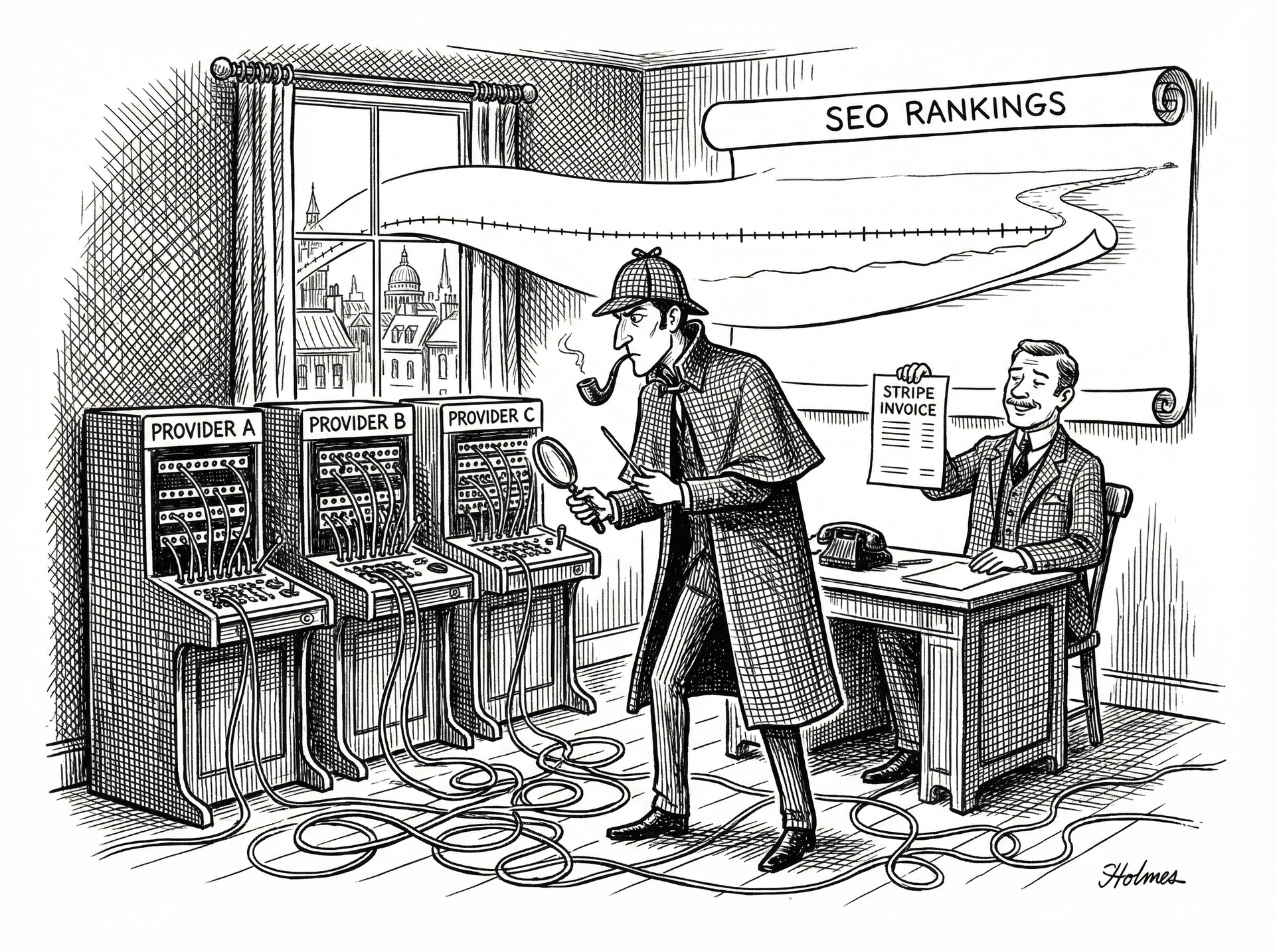
9 providers in 2 days

The core value of Sherlock is cross-provider correlation. One investigation should span Twilio, ElevenLabs, and HubSpot simultaneously — not require three separate queries. That means the integration layer has to be solid before anything else matters.
We shipped 9 provider integrations in v0.2: Twilio (call logs, error codes, webhook history, billing records), ElevenLabs (TTS session data, latency, character usage), Vapi (call logs, webhook events, agent config), Retell (call logs, agent events), Genesys, Amazon Connect, HubSpot (contact records, deal timeline, call activity), and Datadog (metrics, logs, alerts, monitors).
Each provider has 3–6 investigation tools — not just a data dump but targeted queries: get_call_error_codes, get_tts_latency_for_session, correlate_call_with_crm_contact. Anthropic's tool-use API selects the right combination per question. Credentials are validated with a live test API call on connect — if the key does not work, Sherlock tells you before saving it.

Billing: free tier and Stripe live mode

The Starter plan (free, 8,000 credits, no card required) bypasses Stripe entirely — we create the subscription directly in Supabase. No payment friction for free users. No failed free-tier Stripe webhooks to debug. Clean separation between free and paid tiers at the infrastructure level.
Paid Team plans go through a unified Stripe-backed server-side flow with proper plan verification on every request. We went live in Stripe production mode in week 1. Test mode is not a proxy for production behaviour — we verified the full billing path on real Stripe infrastructure before any user touched it.
The credit system in v0.1 charged per tool call — a rough proxy for actual cost. The better model (actual token usage) shipped in v0.10. More on that in the week 3 post.

SEO infrastructure: comparison pages, blog pipeline, GDPR

The SEO work in week 1 was about building infrastructure that compounds — not one-time optimisations.
Competitor comparison pages. The first batch of /compare/vs/[competitor] pages went live. These are Bottom-of-Funnel kill pages: engineers searching 'Datadog alternative for voice calls' are the highest-intent traffic that exists. The dynamic route auto-generates from a single data object — adding a new competitor takes 30 minutes, not a new page build.
Automated blog pipeline. Blog posts generate automatically each week and publish to the site. 10 historical posts seeded at launch covering Twilio debugging, ElevenLabs latency, Vapi errors, and voice AI operations. A growing library of practitioner-grade content with no per-post manual effort.
GDPR + Legal stack. Aviso Legal (Spain), GDPR legal basis documentation, EU consumer rights, VAT compliance, and a cookie consent banner compliant with GDPR, the ePrivacy Directive, and AEPD (Spain). We are an EU-founded SaaS and compliance is not optional.
Heartbeat monitoring. Scheduled cron jobs now check provider health and send workspace digests on a configurable schedule. Provider outages that would previously surface only when a user investigated an incident are now detected proactively.

The interactive demo: the hardest thing to get right

By the end of week 1 we had the interactive demo in early implementation. A Slack-like interface showing a simulated Sherlock investigation — real AI-generated responses, real investigation steps — with no login required.
The demo is the single most important marketing asset for a Slack-native product. You cannot describe the experience in a paragraph. You have to show the investigation happening in real time: tool calls firing, findings accumulating, a sourced case file appearing in the thread. The demo had to be polished enough that a skeptical voice AI engineer spending 90 seconds on it walks away convinced.
Week 2 covers the demo going live, 9 viral growth loops, and the Slack formatting overhaul that made Sherlock production-grade.

Explore Sherlock for your voice stack

Frequently asked questions

Which voice providers does Sherlock Calls support?

Sherlock connects to Twilio, ElevenLabs, Vapi, Retell, Genesys, Amazon Connect, HubSpot, and Datadog — with ClickHouse and PostgreSQL available as database integrations as well. Each provider has 3–6 investigation tools: call logs, error codes, TTS session data, latency metrics, cost breakdowns, and CRM events.

How does Sherlock validate provider credentials?

Each connection is validated with a live API test call on connect — if the key does not work, Sherlock tells you before saving it. As of v0.9, all credentials are stored encrypted at rest with AES-256-GCM. Keys are never stored in plaintext.

Share

Ready to investigate your own calls?

Connect Sherlock to your voice providers in under 2 minutes. Free to start — 100 credits, no credit card.